
Overview
What is Health Collaborative?
I wrapped up my Master's in Human-Centered Design & Engineering at UW with a health-centered service design capstone project (Health Collaborative). Microsoft sponsored my team, with mentorship from Kari Rowles, Guillermo Barquero, and Kayla McVey. My teammates were Michelle Le, Tomomi Matsuzaki, and Kaitlyn Zhang.
We focused on learning how we could help patients build better relationships with their providers while working within the pandemic overtaxed healthcare system. We looked at both sides, patients and providers, to figure out why things weren’t working and how we could meet everyone’s needs.
My Role
Research: I organized the literature review, drawing on research skills from my history degree and an earlier grad-school research group on healthcare infrastructure.
Design: I focused on interaction and systems design, helping the team think through how the service would work for users in the real world.
Prototyping: I led the Care Check-Ins component, bringing implementation experience from my NIH/NIAID work to help make sure our designs would hold up in a real product.
Results
At the department’s showcase, we were finalists for the Bravery and Creativity Awards and we won the 2023 Graduate Innovation Award
We delivered a prototype of our service that prioritizes empathy and understanding. It covers an end-to-end patient experience: building trust for healthcare institutions and providers pre-appointment, empowering patients to collaborate with providers during appointments, and supporting patients through continuing care.
Research
Literature Review
We reviewed and pulled together 30+ research articles on healthcare. We started broad, with general articles on holistic (also known as whole-person) healthcare, then moved into medical research from sources like the National Institutes of Health (NIH), the National Library of Medicine's PubMed database, and the National Center for Biotechnology Information (NCBI).
We kept going back to the medical journals as the project moved forward, checking our personas and findings against it along the way.
Patient Interviews
We looked for patients who'd been seeing providers for the same condition over time because that would be long enough to have a real relationship to describe. Why did they stay with a doctor? Why did they leave? How did they feel before an appointment, during it, afterward? What mattered to them most?
We recruited 8 participants who met three requirements: they'd received healthcare treatment in the United States, had visited doctors for more than just preventative check-ups, and had seen 2+ medical professionals for the same health condition in the last 5 years.
We were open to any health condition and aimed for a range of ages, landing on an even gender split of 4 women and 4 men.
Provider Interviews
We recruited 7 providers with at least 5 years of practice: 4 doctors, 2 nurses, and a social worker (or behavioral health consultant), split 5 women and 2 men. That range of roles helped us understand more of the systems involved in care, not just the patient-facing side.
We also spoke with a service designer at Seattle Children's Hospital and the Dean from the University of Arizona Tucson's Medical School, who helped surface the value tensions between patients and providers — a perspective that ended up shaping a lot of our thinking.
Findings
Shared Values: Collaboration & Education
Patients wanted to feel like an active partner in their own care, not just a passenger. Providers wanted the same thing — patients who showed up ready to collaborate, and who could carry what they learned home with them.
Patients
Collaboration
“I want my doctor to be a very interested listener and show up like my partner. I like to look at various pathways, and we choose the pathway together.”
Education
“[Doing my own research] made me feel like I was doing something... and being able to play one aspect of it was nice, even if it was ultimately not that impactful.”
Providers
Collaboration
“The patients that we tend to love work with are patients who are trying to collaborate as much as possible with us and move the coaching skills to home.”
Education
“When patients don’t understand, we write things down on the board in a visual way which is more helpful when explaining technical terms.”
Core Tension: Trust vs. Capacity
Patients want an emotional connection with a provider they can trust through a vulnerable time. Providers have to divide that same time and care across every patient, while protecting their own burnout.
Patients
Bring large amounts of medical history ahead of time
Share the data in patient portal pre-appointment
Providers
Get information overload from patient submissions
The portals don't match their workflow
They prefer hearing key details directly from the patient because it's often more medically impactful than writings
Going Forward
We decided to go after collaborative decision-making because it was something both patients and providers wanted, independent of each other. We found that communicating concerns earlier in the process was essential to making that collaboration actually work, so we focused on both.

Design
Our Co-Design Workshop

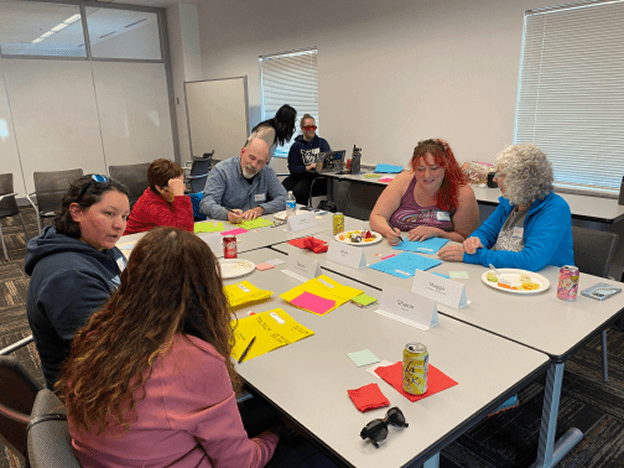
Bringing both sides together
We brought together 3 patients, 2 providers, and a hospital service designer for a co-design workshop, pairing patients with providers so each could see the relationship from the other's side — what a patient was actually thinking, and what a provider was actually weighing.
Dreaming Up the ideal relationship
We gave them one question: what does your dream patient-provider relationship look like? To free up the conversation, we took two things off the table — cost and insurance — and asked them to focus on what they needed from each other, how it made them feel, and how they'd actually want to communicate.
What we learned
We had our participants group their thoughts into an affinity diagram at the back of the room. Both patients and providers reported feeling more positively towards the other group by the end, and we came up with the following design principles:
Design Principles: The Must-Haves
Simple & Intuitive
Simple enough that it doesn't add extra burden to patients or providers.
Empathetic
Warm, supportive, and compassionate through color, tone, and features that invite people to share their experiences.
Flexible & Inclusive
Customizable enough to work for patients with different needs and preferences.
Comprehensive yet Scannable
Enough information to keep everyone informed, structured so it can be understood quickly.
Accessible
Usable regardless of ability, and responsive across devices and screen sizes.
Our Artifacts
Our Artifacts
We turned our research into four artifacts: an ecosystem map, two patient personas, current and ideal state journey maps, and a service blueprint. Click any graphic to expand it — they're collapsed by default to keep the page from running too long.
Building the Ecosystem Map
An ecosystem map lays out everyone and everything a person interacts with while doing something — in our case, everything a patient touches across a full care journey. It's how we saw the full picture at once, instead of guessing. Every actor, tool, and need in a patient's journey, mapped across four phases of care.
Open Ecosystem Map
Personas: Collaborative Cora and Hands-Off Harry
Personas are fictional patients built from real interview data — a way to represent recurring patterns instead of designing for one person. We built two: Collaborative Cora, who wants to research alongside her provider and choose a path together, and Hands-off Harry, who trusts his provider's judgment and wants just enough information to manage his symptoms.
Open Personas
Journey Maps & Service Blueprint
My team and I mapped the current and ideal patient and provider journey maps, plus a full service blueprint. They're all too wide to embed here, so I've linked the full versions in this Figma file below.
Prototyping Service Components
Patient Onboarding: Start the Relationship Right
The onboarding survey captures what a provider needs to know before that first appointment:
Care strategy: how much mental load a patient wants to take on, and whether they lean toward western or alternative care
Communication: family involvement, emotional support needs, language barriers, or comfort with technology
Special accommodations: cultural, spiritual, or religious considerations, and any history of discrimination or trauma that could affect their care
Patients know upfront that their answers will be shared with their provider. That transparency, and having a provider walk in already informed, helps establish trust before the relationship even starts.
Patients know upfront that their answers will be shared with their provider. That transparency, and having a provider walk in already informed, helps establish trust before the relationship even starts.
Appointment Assistance: Conversation Guide
The Conversation Guide gives patients a head start on figuring out what they truly need before they walk in, so a short appointment doesn't get wasted. It leaves room for them to steer their own care and bring up what's actually bothering them.
Providers need to know patients actually understood a recommended care plan, not just nodded along. That conversation needs real space, not a rushed afterthought at the end of a visit.
The guide also lists questions other patients with the same condition tend to ask, so people have somewhere to start and the confidence to actually speak up.
Collaboration: Care Progress & Feedback
Our Care Progress and Collaborative Feedback check-ins support patients between appointments. Patients report their treatment status and any changes they want to make, without needing a full meeting for a quick update.
We heard this repeatedly in provider interviews and co-design sessions: the highest risk of medical error happens between appointments, not during them.
Our Care Timeline keeps everyone on the same page. Patients see exactly where they are in the process. Providers see how a patient is doing, even with outside specialists or testing centers.
Next Steps
Building My Own App
I'm carrying this research into a new project I'm building on my own, combining the research insights from this work, novice hardware and microcontroller skills, and my own experience as a patient. It narrows the scope from both patients and providers down to just the patient side, and it's meant to help with chronic illness self-management, starting with my own migraines. I'm building a custom posture sensor and connecting the app to Apple Watch data using Next.js and other fun coding techniques.
Wrapping Up
Discovering Service Design
Service design was a new challenge for me — a year spent learning to run co-design workshops and think in systems, not just screens. I loved getting to use my NIH work experience and the insights from my healthcare research group to shape how I approached the project from the start. I got to talk to people I never expected to meet, like a social worker helping unhoused patients get care and a transplant surgeon walking me through the mental health requirements for major procedures. It left me more aware of how much privilege it takes to have easy access to your own wellbeing.
Most healthcare tools treat patients and providers as separate audiences. My team and I set out to prove that it didn't have to be true, and I'm proud of what we found. Our capstone was a great thought experiment, but real healthcare research needs time and funding our program didn't give us, and given how directly this work touches people's health, I want to take that seriously before calling it done.